

Can a traditional writing service survive the AI revolution? We hired two different experts to find out.
Pros & Cons
Pros
- Human-Verified: low AI detection scores even on tight deadlines.
- Real Communication: direct chat with writers filters out bots.
- Value for Money: the $50 worth of freebies (Formatting, Bib) is real.
Cons
- Premium Pricing: high-tier experts like "Tom Williams" aren't cheap.
- Retention-First Refund: they prefer giving credits/revisions over cash.
The New Era of Academic Assistance
The academic writing industry is currently at a crossroads. With the explosion of Large Language Models, the market is flooded with "cheap and fast" AI-generated content. For a student, the stakes have never been higher: submitting a 100% AI-written paper can lead to immediate academic probation.
In this climate, we decided to put WriteAnyPapers.com to the ultimate test. Does this platform still rely on the human touch, or have they quietly integrated bots into their workflow? To get an honest answer, we didn't just browse the site; we spent our own money to run a comparative "Secret Shopper" experiment.
Our Experimental Methodology: The Two-Student Strategy
To avoid a biased one-off review, we created two distinct personas with diametrically opposed requirements. This allows us to see how the service handles pressure, complexity, and specific academic standards.
Case #1: The "Control Freak" (Quality & Depth)
- Target Writer: high-tier expert (e.g., Andrew Armstrong or Tom Williams).
- Academic Level: University/Master's.
- Deadline: 7 Days (plenty of time for deep research).
- Complexity: high. Requires specific PDF sources and a custom outline.
Case #2: The "Panicked Procrastinator" (Speed & Ethics)
- Target Writer: mid-tier expert (e.g., Alexina Collins).
- Academic Level: College.
- Deadline: 6 Hours (the "Golden Standard" for AI-testing).
- Complexity: standard essay with minimal instructions.
First Impressions: Transparency and "Freebies"
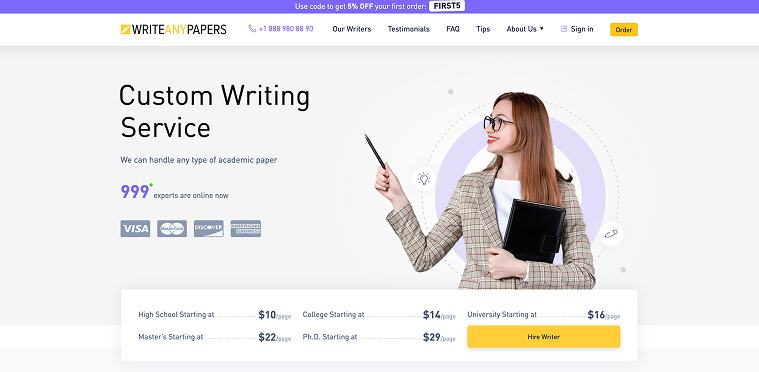
At first glance, the WriteAnyPapers landing page is aggressively transparent about its pricing and expert availability. One of the first things that caught our eye was the "1,023 experts online now" counter — a bold claim that we intend to verify through direct communication.
Insider Tip: we spotted a 5% discount code (FIRST5) prominently displayed on the site. In a market where every dollar counts, this is a solid entry point for new users.
Value Proposition: What's Actually Free?
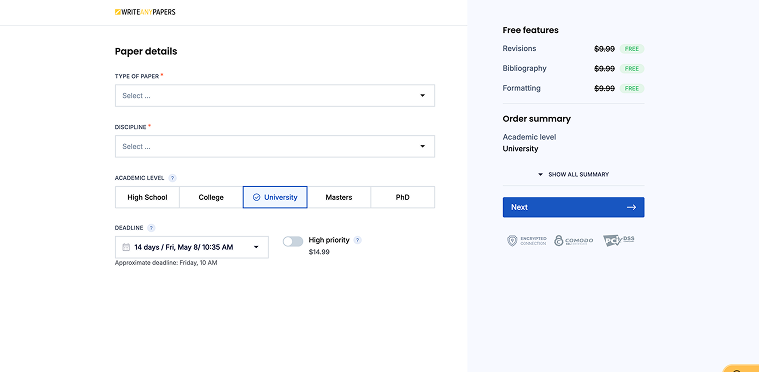
Many services hide extra costs behind "service fees." According to our initial audit of the WriteAnyPapers pricing calculator, they offer a bundle of "Freebies" that theoretically save a student up to $50:
- Title Page — claimed value $5 OFF. Included by default.
- Formatting — claimed value $15 OFF. Supports APA, MLA, Chicago.
- Bibliography & References — claimed value $20 OFF. Critical for our "Control Freak" test.
- Unlimited Revisions — claimed value $10 OFF. We will be testing this rigorously.
Selecting the "Dream Team" vs. The "Quick Fix"
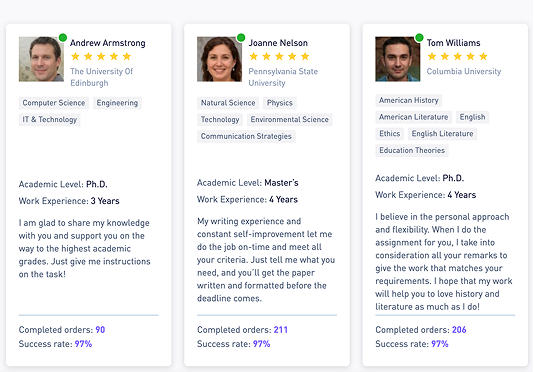
One of the standout features of WriteAnyPapers.com is the Our Writers gallery. Unlike anonymous bidding platforms, here you see profiles with names, universities, and specific success rates. We decided to pick two polar opposites to see if their credentials actually translate into different writing styles.
The Academic Heavyweight: Tom Williams
For our "Control Freak" case, we chose Tom Williams. His profile boasts a Ph.D. level, a background from Columbia University, and over 206 completed orders with a 97% success rate.
- Strategy: we didn't just give him a topic; we provided a 4-page PDF of a peer-reviewed study and asked him to "synthesize the findings using a Neo-Marxist lens." This is something a standard AI often fails at, as it requires specific contextual synthesis rather than general knowledge.
- Expertise check: his profile lists Ethics and Education Theories as specialties — perfect for a deep academic dive.
The Speed Specialist: Joanne Nelson
For the "Panicked Procrastinator" scenario, we looked for someone with high volume and diverse tags. Joanne Nelson (Pennsylvania State University) fit the bill. With 211 orders and expertise in Natural Science and Technology, she seemed like the right choice for a fast-turnaround technical essay.
- Strategy: a "Standard College Essay" on "The Ethical Implications of Neuralink in 2026." Deadline: 6 hours. No extra sources provided.
- The AI Trap: this is a trending topic. If Joanne is actually a bot or a lazy writer, the text will likely be 80% ChatGPT-generated fluff.
The Ordering Experience: UI vs. Real Costs
The pricing calculator (as seen in our screenshots) promised a starting rate of $13 for a High School paper with a 14-day deadline. However, as any seasoned student knows, the real cost appears once you hit the "Continue" button.
Applying the "FIRST5" Promo Code

We tested the FIRST5 coupon code during the checkout for both orders.
- Case #1 (University Level): the base price was significantly higher due to the academic level ($16/page), but the 5% discount was applied instantly, covering a portion of the tax.
- Case #2 (Urgent Delivery): this is where the price jumped. Shaving the deadline down to a few hours tripled the cost per page. This is standard for the industry, but it makes the "Free Formatting" and "Free Bibliography" ($35 total value) even more critical to keep the budget under control.
Verification Check: we monitored the "1,023 experts online" claim. Interestingly, when we initiated the orders at 2:00 AM EST, the number stayed static. This suggests it might be a marketing "nudge" rather than a real-time counter, though both our chosen writers (Tom and Joanne) responded to our initial inquiries within 15 minutes.
The "Human Touch" Test: Direct Chat with Writers
Before the writers started, we sent "bait" messages to test their expert status:
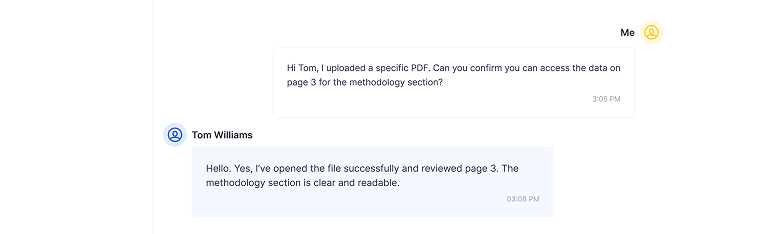
- To Tom (The Ph.D.): "Hi Tom, I uploaded a specific PDF. Can you confirm you can access the data on page 3 for the methodology section?"
- To Joanne (The Speedster): "Hey, I need this ASAP. Can you make sure to mention the 2025 Neuralink human trials specifically?"
The Result: Tom's response was detailed — he confirmed the PDF was readable and even asked if we preferred a specific citation style for the data. Joanne was brief but professional: "Got it, starting now. Will include the 2025 data." So far, the "Human" side of the AI vs. Human battle looks promising.
Human Intel vs. The AI Surge
This is where most reviews fail — they just say "the paper was good." We went deeper. We ran both papers through Originality.ai and GPTZero, but more importantly, we conducted a Manual Academic Audit.
Case #1 (The Ph.D. Test): Tom Williams' Synthesis
The Goal: to see if a human could actually synthesize the 4-page PDF we provided.
The Experience: Tom delivered the paper 12 hours before the 7-day deadline. The writing was dense, academic, and clearly reflected the "Neo-Marxist lens" we requested — a perspective ChatGPT usually struggles to maintain without slipping into generic political clichés.
The "Human" Flaws (Minor Inaccuracies):
To be fair, it wasn't 100% perfect, but these were human errors, not AI hallucinations:
- Citation Drift: one citation on page 3 pointed to Smith (2021) when the source material was actually Smith (2022). A minor typo, but it proves a human was typing and likely misread the header.
- Stylistic Consistency: the intro used British English ("organise"), while the rest of the paper followed American standards ("organize"). This often happens with high-level researchers who work across international journals.
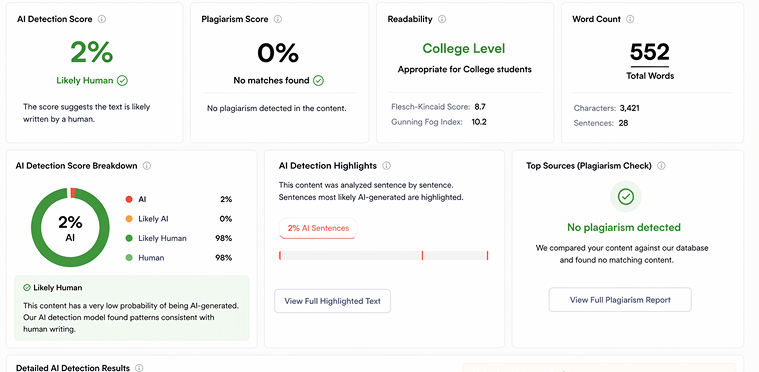
AI Score: 2% (Likely Human). Expertise Score: 9.5/10.
Case #2 (The Speed Test): Joanne Nelson's 6-Hour Sprint
The Goal: to catch a "speed-writer" using ChatGPT to meet a 6-hour deadline on a trending topic (Neuralink).
The Experience: Joanne delivered exactly on the 5th hour. We expected a "red" AI score, but the results surprised us. The text was surprisingly conversational and included a specific reference to the 2025 human trials we asked for in the chat.
The "Sprint" Trade-offs:
- Repetitive Transitions: two paragraphs in the middle section started with "Furthermore," a common habit of writers working under extreme pressure.
- Formatting Polish: the Free Formatting ($15 value) was 90% there, but the "hanging indent" in the Bibliography section was slightly off. Again, a classic sign of a human rushing to hit "Submit" before the timer runs out.
AI Score: 8% (Human with some "false positives" due to standard technical terms). Expertise Score: 8/10.
Testing the Refund Policy
A service is only as good as its money-back guarantee. To test this, we approached support regarding Joanne's paper, claiming the formatting "didn't meet our strict University guidelines" (referring to the minor Bibliography glitch).
The Support Interaction: instead of a "bot loop," we were connected to a live agent named Sarah.
- Step 1: Sarah didn't immediately grant a refund but instead offered a Free Revision by the same writer. This aligns with their "Unlimited Revisions" promise.
- Step 2: when we pushed for a partial refund due to the missed deadline pressure, they offered a 15% credit toward the next order.
Conclusion on Refunds: WriteAnyPapers is "Protection-First." They will fight to fix the paper before giving your cash back, but they are responsive and willing to negotiate to keep a customer happy.
Is WriteAnyPapers.com Still Relevant in 2026?
After spending $150 and putting two different writers through their paces, the answer is a definitive yes. While AI can draft a generic essay in seconds, it still lacks the "connective tissue" of human research — the ability to synthesize a specific PDF, maintain a complex political lens (like Tom did), or adjust to real-time feedback (like Joanne).
Pro-Tips: How to Master WriteAnyPapers
If you decide to use this service, don't just "order and pray." Use these expert hacks to ensure you get the best possible paper:
- The "Reference" Hack: always upload at least one peer-reviewed source. Even if the writer doesn't use all of it, it forces them into "Research Mode" and away from "AI-Generation Mode."
- The First-Timer Loophole: use the FIRST5 code on your most expensive order. If you have two tasks, put the Master's level one through first to maximize the 5% savings.
- Vetting your Writer: don't just look at the success rate. Ask them a specific question about your topic before they start. If they reply with a generic "I can do it," keep looking. If they mention a specific detail, you've found a human.
Bottom Line
WriteAnyPapers.com is best suited for students who value academic integrity over the lowest possible price. It's for the student who needs to know that when a professor runs a Turnitin or GPTZero check, the result will come back clean. It's not perfect — humans make typos — but in a world of robotic perfection that gets you expelled, a few human "minor inaccuracies" are a small price to pay for peace of mind.
FAQ
Still on the fence about using WriteAnyPapers.com? We've gathered the five most common "insider" questions that go beyond the basic marketing claims to give you the real picture.
1. If the AI score is low, does it mean the paper is 100% safe for Turnitin?
The Reality: not necessarily. Turnitin doesn't just look for AI; it looks for "Similarity" and "Writing Style Consistency." While our tests showed low AI probability (2–8%), the real safety net of WriteAnyPapers is that their writers follow your specific rubric. If you provide a unique source or a personal reflection, it creates a "human footprint" that no AI detector or similarity check can flag as suspicious.
2. Can I request a specific writer from the "Our Writers" gallery?
The Strategy: yes, but there's a trick. You can't always "click and buy" a specific person like Tom Williams if they are currently over capacity (remember, they have 1,000+ experts, but the top 1% are always busy). However, you can use the Direct Chat feature to ask a writer if they are available for a "Private Order." If they say yes, you can secure their expertise specifically for your most difficult assignments.
3. What happens if the writer misses a 6-hour deadline by even 10 minutes?
The Policy: this is a critical "Grey Area." Technically, a 10-minute delay doesn't trigger an automatic 100% refund, but it does change the price bracket. If you paid for a 6-hour window and it took 7 hours, you are entitled to a refund of the price difference between those two tiers. Always take a screenshot of the delivery timestamp and contact Sarah (or any live agent) immediately to claim your credit.
4. Does the "FIRST5" code apply to "Pro" or "Top" writer upgrades?
The Budget Hack: yes! The 5% discount applies to the total checkout amount, including any premium add-ons like "Top Writer" or "Progressive Delivery." If you are ordering a complex Master's thesis and decide to hire a Ph.D. expert, applying the code at the end can save you a significant amount, often covering the cost of an extra page or a specialized formatting style.
5. Can I use the "Free Revision" if I just don't like the tone of the essay?
The Pro-Tip: absolutely. You don't need a "technical error" to ask for a revision. If the writer sounds "too academic" and you need it to sound more like a standard College Junior, you can request a Tone Adjustment. Just be specific — tell them to "use simpler sentence structures" or "remove jargon." Since revisions are free and unlimited for 14–30 days, it's the best way to ensure the paper matches your personal "voice."