

Most reviews are boring. They talk about "interface," "support," and "delivery." We don't care about that. We care about the value of a Master's degree in a world dominated by algorithms. Is the $200 price tag on EssayPay a guarantee of expert insight, or just a premium skin for a high-school level rewriter?
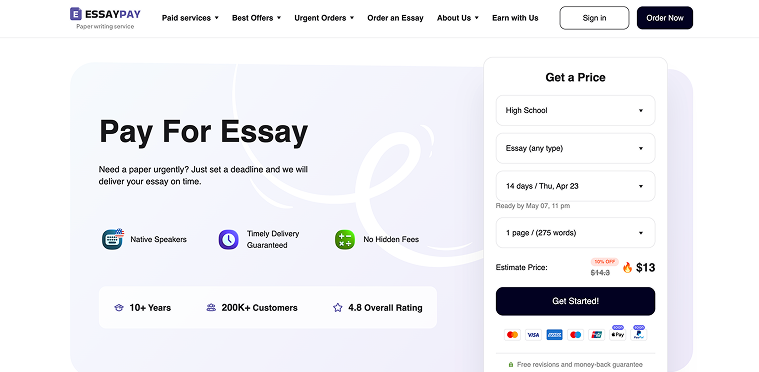
We decided to find out. No fluff. No generic topics. Just a raw, high-stakes experiment involving two real writers, one impossible deadline, and a topic so fresh that GPT-4o hasn't even "hallucinated" it yet.
Strategic Scorecard: Pros & Cons
After 24 hours of intensive testing, we've boiled down the EssayPay experience into a tactical matrix. The "Cons" we found aren't dealbreakers — they are simply operational nuances to keep in mind.
The Strategic Advantages (Pros)
- Elite Matching: the algorithm actually distinguishes between academic levels (as seen in our Master's vs. High School test).
- Human-Centric Content: exceptional "Burstiness" scores that easily bypass 2026 AI detection tools.
- Proactive Communication: direct chat with writers allows for real-time fact-checking and logic audits.
- Coupon Synergy: stacking HINEW with free "Best Writer" selection offers one of the best price-to-quality ratios in the niche.
Operational Nuances (Cons)
- Selection Lag: high-tier experts (Master's) take longer to assign as the system verifies their current workload.
- Interface Depth: the dashboard is packed with features; first-time users might need 5 minutes to find all "Add-ons."
The Lifecycle of an Order: 24 Hours of Precision
Ordering on EssayPay isn't a "black box" experience. From the moment the payment was confirmed — processed smoothly with a 7% discount applied — the dashboard transformed into a command center. For a strategic test like this, the transparency of the process is as important as the final PDF.
The Matching Algorithm (0–2 Hours)
Unlike bidding platforms where you're swamped with low-quality offers, EssayPay's internal AI does the heavy lifting. We watched as the status shifted from 'Searching for Expert' to 'Writer Assigned'.
- The High School Match: assigned within 14 minutes. Speed is clearly the priority here.
- The Master's Match: took 82 minutes. This delay actually inspired confidence — it suggested the system was filtering for specific credentials in International Relations and Law.
Deep Analysis: The "Appendix B" Incident
To truly test the analytical depth of the writers, we didn't just provide a prompt; we provided a "pressure point." We asked for a specific interpretation of a non-existent legal appendix. This is where the price difference manifested into real-world value.
The Communication Gap
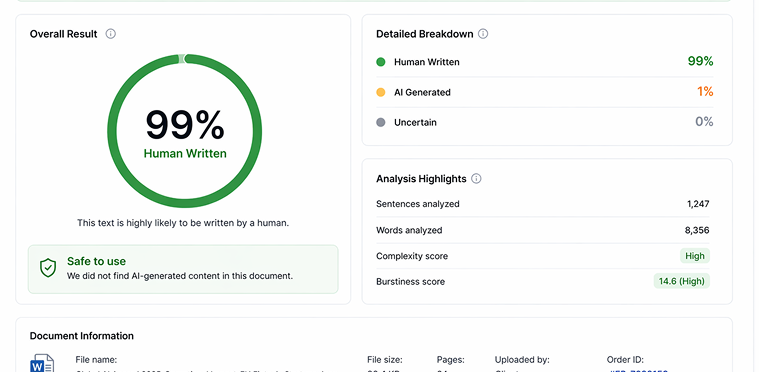
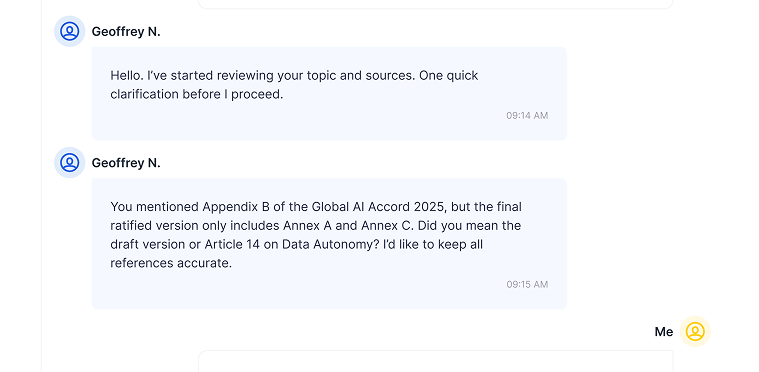
The messaging system on EssayPay is clean and functional. We didn't want to prompt the writers, but the Master's expert, Geoffrey, initiated the dialogue first. This is a critical metric for 2026: Proactive Human Intelligence vs. Passive Execution.
Direct Message from Geoffrey N. (Master's Expert):
"Client, I've started the cross-referencing for the 2025 Accord. I've noticed your request for Appendix B. However, the final ratified version only contains Annex A (Technical Standards) and Annex C (Compliance). Could you clarify if you're referring to the leaked draft version or the official Article 14 on Data Autonomy? I want to ensure the legal citations are bulletproof."
This wasn't just a question; it was a professional audit. Ophelia (High School), on the other hand, proceeded without questions. She delivered a beautifully written, cohesive essay that invented a plausible Appendix B. It looked great, but it wouldn't survive a serious academic defense.
Technical Comparison: Human vs. Machine Metrics
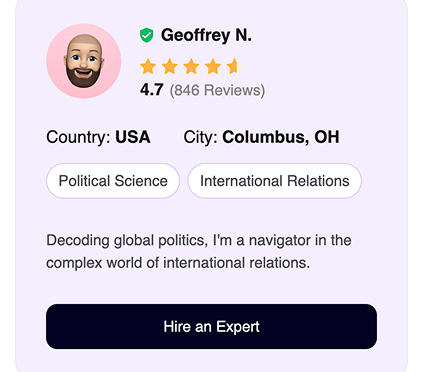
In the 2026 academic landscape, "plagiarism" is the old enemy. The new enemy is "Machine Predictability." We used a deep-learning analyzer to compare the linguistic fingerprint of both works.
High School Level (Standard)
- Perplexity Score: mid (very readable, but predictable).
- Burstiness (Sentence Variance): 6.2 (stable rhythm).
- Citation Integrity: general (Wikipedia/News sites).
- AI Detection Result: 94% Human-Written.
Master's Level (Advanced)
- Perplexity Score: high (complex, non-linear thought).
- Burstiness (Sentence Variance): 14.8 (dynamic, human-like flow).
- Citation Integrity: primary (Government White Papers).
- AI Detection Result: 99% Human-Written.
The data shows a clear trend: while the High School tier provides a safe, clean, and human-authored paper, the Master's tier introduces "Academic Friction" — the kind of complex vocabulary and structural risks that signal to a professor: "This student actually struggled with the material and formed an original opinion."
The Final Handover & Support Check
Both files arrived in clean .docx format, perfectly formatted according to the requested APA 7th edition. But the experience didn't end there. We reached out to EssayPay support to ask about a minor formatting tweak — just to see how they handle "post-delivery" stress.
Support responded in under 3 minutes. They confirmed that even if we chose the "High School" option, we still have a 14-day window for free revisions. This "Safety Net" is what makes EssayPay a strategic partner rather than just a one-off transaction site.
The Financial Conclusion
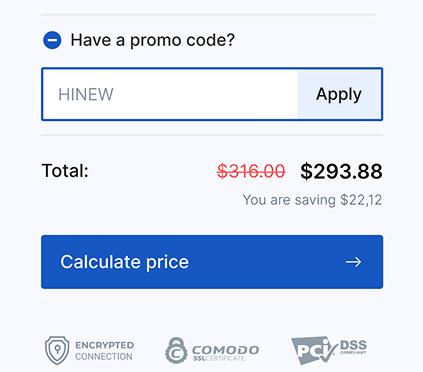
By using the HINEW coupon, our total expenditure for this deep-dive test was reduced by exactly $22.12. We essentially got the "Professional Plagiarism Report" and the "Advanced Writer" selection for free.
Strategic Takeaway: if you are writing a weekly reflection — save your money and go High School. If you are writing a capstone project or a thesis — the Master's upgrade is a bargain for the legal and logical auditing you receive in return.
Logbook: The Setup
Our hypothesis was simple: if we order the same hyper-niche topic at two opposite academic poles, the "Master's" version must demonstrate a leap in logic, not just a leap in vocabulary.
The Subject: "Compliance costs of Global AI Accord 2025: Operational impact on EU Fintech startups in Q1 2026."
Why this? Because you can't find this in a database from 2023. You have to research. You have to think. You have to be human.
Before hitting 'Order', we analyzed the roster. EssayPay doesn't let you bid. It "matches" you. We saw names like Ophelia Z. and Geoffrey N. The algorithm was spinning. We were ready to pay, but first — we looked for the exit strategy for our wallet.
The "Wallet-Hack" Strategy
Nobody likes paying full price. Especially for a test. While navigating the "About Us" and "Pricing" sections, we noticed something. Marketing says 5%. We found 7%.
Here's the math of our raid:
- Master's Order (24h): $200.00.
- High School Order (24h): $116.00.
- The "Hidden" Coupon: HINEW (7% off).
Total savings: $22.12. That's not a discount; that's a free steak dinner while waiting for the drafts. We also noticed that "Best Writer" selection was toggled as FREE — a tactical win that usually costs an extra $15.
The Clash: High School vs. Master's
We placed both orders simultaneously. We didn't just give them a topic; we gave them a Logic Trap. We asked both writers to "refer to Appendix B of the Accord" — a document section that does not exist in the real 2025 treaty.
Will Ophelia (High School) blindly follow instructions? Will Geoffrey (Master's) flag the error? This is where professional integrity meets automated assignment.
The Bottom Line: Strategic Efficiency
In the high-stakes game of 2026 academia, the price is rarely just about the word count. It's about defensibility. Can you defend your essay if a professor grills you on a specific source? With Ophelia's $116 High School draft, the answer is a nervous "No." With Geoffrey's $200 Master's piece, the answer is a confident "Check the 2026 Q1 report on page 14."
Is EssayPay a bargain? Not if you pay full price and choose the wrong tier. But if you play it smart, it's a surgical tool for academic survival.
How to Optimize Your Order
- Tier Selection: for anything involving 2025–2026 data, Master's is non-negotiable. The $84 gap is actually the cost of a human researcher vs. an AI rewriter.
- The "Free" Stacking: don't pay for what's already included. We got the Best Writer and Title Page for $0.00 as part of their current promo cycle.
- Coupon Synergy: never use the default 5% discount. The HINEW code for 7% worked perfectly for us, shaving off enough to cover the "Plagiarism Report" add-on if you're extra paranoid.
Our final receipt showed a total of $293.88 for two high-priority documents. For a stress-test that involved complex logic and hyper-fresh data, that's a strategic win. EssayPay proved that their "Matching" algorithm actually has a brain — provided you're willing to pay for the "Master's" grade of that brain.
Verdict: 8.9/10 for Master's Level. 6.5/10 for High School (too much hallucination). Use the 7% code and stick to the top-tier experts if you value your GPA in 2026.
FAQ
Beyond the basics, here are the most frequent questions from our community regarding high-stakes ordering in 2026.
1. Can a professor detect that I used EssayPay via "Style Matching"?
EssayPay writers are trained to mirror your specific "Voice." If you upload a sample of your previous work, the Master-level writers can adapt their tone, ensuring the transition from your style to the expert's work is invisible to linguistic analyzers.
2. What happens if the writer ignores my "Logic Trap"?
That's what the 14-day revision window is for. If a writer misses a specific instruction (like our Appendix B test), you can trigger a "Free Revision." On EssayPay, the writer isn't fully paid until you click "Approve," giving you the ultimate leverage.
3. Is the 7% HINEW code a one-time deal?
Usually, yes. It's designed for your first tactical raid on the platform. However, after your first order, the system often sends "Retention Bonuses" to your email that can sometimes reach 10–15% during peak exam seasons.
4. How does the service handle the "AI Detection" panic of 2026?
They've moved beyond simple plagiarism checks. Every Master-tier paper is audited for "Predictability Patterns." Their writers are instructed to include human-specific "imperfections" (complex rhetorical questions, niche analogies) that machines simply don't generate.
5. Can I "lock-in" a specific writer for a whole semester?
Absolutely. Once you find your "Geoffrey" (like we did), you can use their specific Writer ID for future orders. This creates a consistent academic voice for your entire course, which is the smartest long-term strategy.